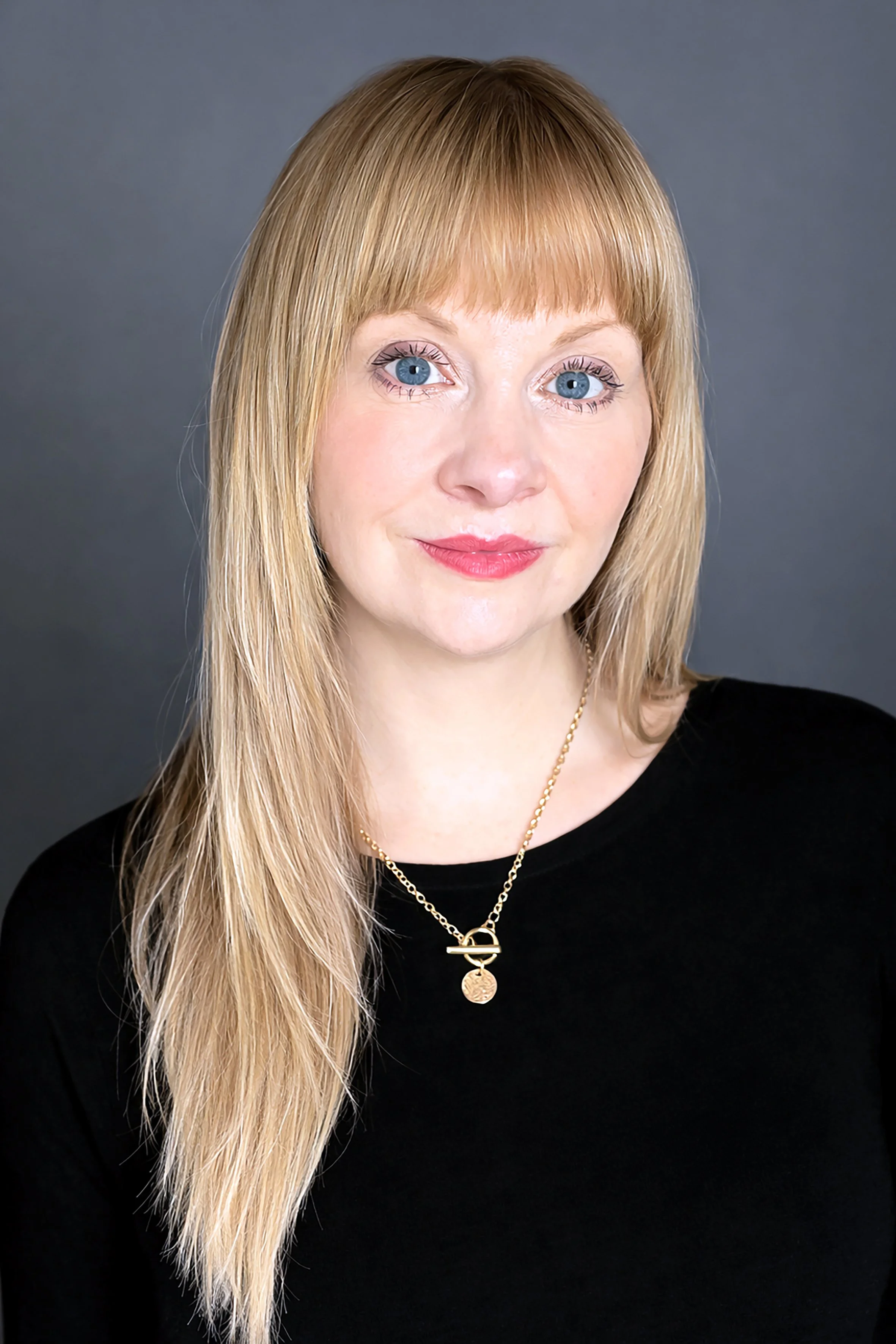
Charley Peters is a painter and public artist exploring how contemporary images move between simulation, materiality and physical space.
Charley Peters is a painter and public artist based in Lewes and London. Her work explores the strange objects and environments produced by technologies of image-making, from computer graphics and simulated spaces to AI-generated imagery. Drawing on these visual languages alongside histories of abstraction and still life, her paintings create hybrid spaces in which synthetic images become unstable, material things.
She has exhibited widely in the UK and internationally, including recent presentations at Meakin + Parsons, Oxford; Kelly McKenna Gallery, New Jersey; Hauser & Wirth, London; Z20 Sara Zanin Gallery, Rome; Yantai Art Museum, China; and the National Museum of Gdańsk, Poland.
Her work has been commissioned for public spaces and cultural institutions including Facebook, Wembley Park, Hospital Rooms, ITV and London Art Fair.
Peters holds a PhD in Fine Art Theory and Practice and writes about contemporary painting, technology and visual culture. Her writing has been published by Instantloveland, Turps Banana, A-N and Abstract Critical, alongside ongoing essays exploring painting, images and contemporary culture.
She is Head of Graduate School at City & Guilds of London Art School, Lead Mentor at Turps East Sussex and a PhD Supervisor at University of the Arts London.
BETWEEN THE SCREEN AND THE SURFACE:
Painting, simulation and the strange life of images.
My work begins with a fascination with constructed images: how we make them, how we believe in them, and what happens when they move between virtual and physical worlds.
I grew up in Birmingham, a concrete metropolis lit by sodium streetlights and neon shop signs. Much of my childhood was spent drawing and building imaginary worlds out of paper and colour. I was obsessed with robots, spaceships, dinosaurs, fossils and ghosts. My early visual language came from pixelated video games, sci-fi book covers, heavy metal album covers and the glow of cartoons on television screens. Technology was everywhere, but it still felt new and magical.
That fascination with constructed worlds has never really left me. I’m interested in images as technologies: systems for organising space, directing attention and producing convincing fictions. Painting has always been part of that history, from the perspectival spaces of Renaissance painting to abstraction, photography, cinema, computer graphics and the synthetic images generated by AI.
Contemporary image technologies have intensified these questions. Digital imaging, simulation tools and generative systems now allow images to exist without straightforward relationships to physical objects or events. In the studio, I use these technologies speculatively, generating and manipulating forms that hover somewhere between recognisable things and impossible ones: fragments of machinery, organic matter, geometric structures, reflective surfaces and objects that appear simultaneously familiar and strange.
Painting gives these images another kind of existence. Translated into paint, the seamless surfaces of synthetic imagery begin to break down. From a distance, my paintings can appear digitally rendered: metallic forms hover in ambiguous spaces, structures intersect with luminous gradients, and objects seem to possess the frictionless perfection of computer graphics. Up close, that illusion dissolves into brushstrokes, glazes, edges, corrections and material gestures.
I’m interested in this perceptual slippage: the moment when an image moves between illusion and object, representation and abstraction, digital precision and painterly uncertainty. Rather than treating abstraction and figuration as opposites, I think of them as unstable conditions that an image can move between. A shape might resemble a machine part, a body, a piece of architecture or nothing identifiable at all. Meaning emerges through the act of looking.
This is also why I’m increasingly interested in the strange objects that populate contemporary images. Digital culture produces things that seem to belong to the physical world but never quite existed there. AI intensifies this condition, generating objects with plausible surfaces but uncertain identities and impossible structures. Painting allows me to slow these images down, examine them and give them weight, scale and material resistance.
Although painting sits at the centre of my practice, the work frequently expands beyond the canvas. Murals, public commissions and installations allow pictorial space to migrate into architecture and the built environment. In these works, questions that begin within paintings become spatial: images are encountered through movement, scale and the body rather than from a single viewpoint.
Across my painting, writing and public work, I return to the same underlying questions: how do technologies shape what we see? What happens when images become detached from the things they appear to represent? And what can painting do within a culture increasingly populated by simulations, synthetic images and uncanny spaces?
The studio is where these questions remain deliberately unresolved. Like the imagined worlds I drew as a child, it is a place where images can be built, dismantled and rebuilt again. It remains a space for discovering what painting might become after the image has already happened.